Search for Trees

Showing posts with label 0) Trees of Legend. Show all posts

Sunday, June 21, 2009

The Lotus Pond Wingnut

Every once in a while I come across a tree that makes me stop and stare in awe, and the Lotus Pond Wingnut was one of those trees. I had not set out looking for the Wingnut, but found it while exploring the grounds of Cave Hill Cemetery in Louisville, KY.

Wingnut Tree The tree is a Caucasian Wingnut (Pterocarya fraxinifolia). I call it the Lotus Pond Wingnut because it grows in the Lotus Pond section of the Cemetery.

Wingnut Seeds

The Wingnut name is dervied from the literal observation of its winged seeds.

Wingnut Catkins
Catkins could be seen on the tree during my visit.
Wingnut Bark
Wingnut Bark
Wingnut Scale
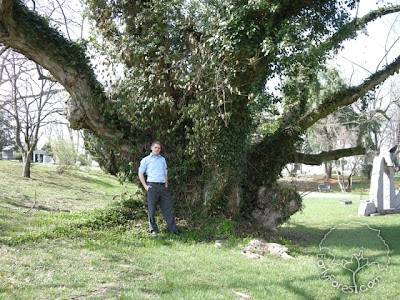
I stand infront of the tree to show the scale of its width.

One of the factors that makes this tree so impressive is the size of its trunk. It is recorded have a circumference of 21'6", that is over 6 and a half meters. The other factor that makes this tree unusual is its type. Wingnut trees are almost never planted in this part of the United States which makes them quite rare finds.

While most of the grounds at Cave Hill Cemetery are well groomed and pruned, this tree seems to be left to battle the English Ivy (Hedera helix) and Purple Leaf Wintercreeper (Euonymus fortunei) on its own. I have some concern about what the ivy will do to the trunk of the tree over time. It will likely create a moist microclimate under the leaves will accelerate the growth of fungus and create more opportunity for pests and disease.

Ivy on Trunk
Ivy covers the trunk of the tree

Tree with Burrow
Perhaps the ivy is not all bad considering it helps to conceal the burrow of the tree's small furry guardian.

Tunnel
At the base of the tree a tunnel is hidden among the roots and vines.

Red Fox

As I stood infront of the tree a small red fox bounded out of the branches above me and jumped over my head. I had just enough time to regain my composure and turn to capture a photo as it ran across the lawn.

Tree top Tunnel

Under the limb a small tunnel of ivy shows the fox's secret hideaway.

Thursday, May 28, 2009

The History Oak

Located in Murfreesboro, Tennessee on the grounds of The Oaklands Historic House Museum stands a tree simply named "The History Oak". The History Oak is a White Oak that is estimated at over 200 years old.


Care has been taken to protect the tree from wayward lawnmowers that could damage its bark.


The tree is both impressive in size and age and has a generally symmetrical overall shape to it. It appears to be in good health.

A sign displays a time line of local events that have passed during the History Oak's life.

Friday, January 30, 2009

Trees of Legend : The Curtain Fig Tree

A few years ago I had the opportunity to travel through North-Eastern Australia. There are few places that I have traveled that rival the wild beauty of the Australian Rain forest. Along the course of my travels I passed through the Yungaburra National Forest where one of nature's ancient wonders dwells to this day.
The Curtain Fig Tree, Ficus virens, is intimidating in size and magnificent in detail. Born from a seed long ago planted in the canopy of another tree, the fig grew in size reaching its roots toward the earth. Eventually the host tree, burdened and buried under the fig, gave way and fell. The fig continued to grow upon the askew tree weaving its roots toward the forest floor.


It is a wonder to behold and I wish that I had a better camera at the time to properly capture it. As I recall, I was in such awe that I nearly forgot to take any photos at all.
I was impressed with the care taken in the protection of the tree. A raised boardwalk circles the tree at a close but safe distance. (safe for the tree anyway: no feet to compact the soil and no knives to carve into the bark.) The visitor has the advantage of viewing the tree from level ground making it very handicap accessible.